
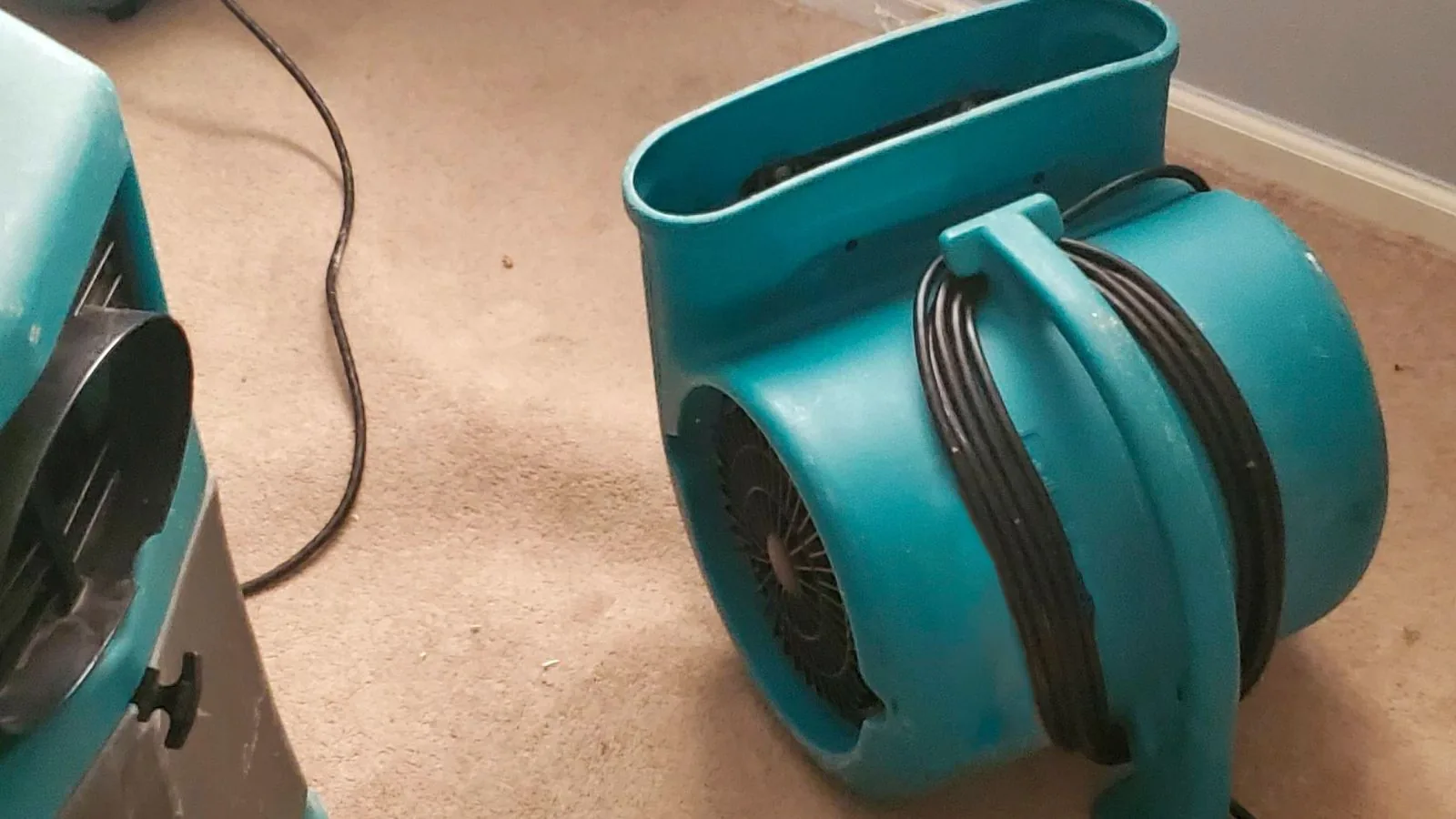
A carpet that stayed wet is two materials at risk: the carpet face and the pad beneath it. The face can look fine while the pad stays damp for days, and the smell is often the first sign. This guide covers what a musty carpet means for the building, the choices and where cleaning stops being enough. It makes no health claims.
Why carpet is a problem material
Carpet is made to be walked on, not to dry fast. The fibers, backing and pad all absorb water, and pad in particular holds it against the subfloor where air cannot reach. That is why contractors so often replace pad even when the carpet is dried and reinstalled. The cost of pad is small, and a pad that stays wet is the source of most carpet odor problems.
Signs of a problem
- A musty smell that is strongest near the floor.
- Carpet that feels damp or cool days after the water stopped.
- Discoloration on the carpet backing or the underside of the pad.
- Dark spotting along baseboards or at the carpet edge.
- A moisture meter reading high at the subfloor or tack strip.
| Situation | Usual approach | Why |
|---|---|---|
| Clean water, extracted within a day | Dry in place or lift and rack, replace pad | Carpet face often recovers |
| Carpet damp for several days with odor | Replace pad, inspect carpet backing, often replace carpet | Odor means moisture stayed |
| Visible growth on backing or pad | Remove affected carpet and pad, dry the subfloor | Cleaning the face does not reach the source |
| Contaminated water | Replace carpet and pad | Porous material cannot be sanitized |
What cleaning can and cannot do
Hot-water extraction and sanitizing products can refresh a carpet that is dry and has surface soiling. They do not dry a wet pad or a damp subfloor, and a carpet cleaner is not a moisture solution. If the odor returns on humid days or after a rain, the moisture source is still there. That points back to drying, not to another cleaning.
What to do first
- Stop the water source and remove standing water. See water extraction.
- Lift an edge of carpet in a corner and check whether the pad is wet or discolored.
- Run fans and a dehumidifier if the area is small, or call for a moisture map if it is larger.
- Do not cover damp carpet with furniture or rugs.
- Photograph the carpet and pad before removing anything, for your records.
The service page on carpet water damage restoration describes how extraction, lifting and drying are done, and structural drying explains how readings decide when the job is finished.
When it is mold and what that means
If growth is visible on the backing, pad or subfloor, the practical step is removal of the affected materials and drying of what remains. Testing is sometimes used to document conditions, and it is often done by an independent party. The mold remediation page covers containment, removal and clearance, and mentions ANSI/IICRC S520 as the industry standard for that work.
Replacement choices
If carpet is replaced, ask about pad with a moisture barrier, and ask whether the subfloor was verified dry before installation. A new carpet over a damp subfloor repeats the problem. Your adjuster may have a scope that sets what is replaced, and matching a carpet across a large open area is a question to raise early.
How to check the pad yourself
Pick a corner or a closet where a loose edge will not be noticed. Pull the carpet gently off the tack strip, fold it back and look at the pad. Damp pad feels cool and spongy, and discolored or dark spots on the underside are a concern. Smell the exposed subfloor too. Press the carpet back down afterward and avoid stretching it, since a poor reinstall adds cost.
If you find damp pad, do not wait for it to dry on its own. Pad holds moisture for days, and the moisture is what feeds a smell. A restoration crew can take a reading at the subfloor, which tells you whether the problem is still active or already over.
A Burlingame note
Many Burlingame homes have carpet over raised foundations, and moisture from a damp crawl space can rise through the floor even without a leak inside. If carpet smells musty after a wet winter and nothing inside has leaked, the underfloor is worth checking. See crawl space water damage for how that is handled.
The city names seven creeks and notes that those west of El Camino Real run along private properties. A home beside a creek can see higher moisture after heavy rain, and Public Works at 650-558-7670 handles creek and storm drain concerns. See the pages for San Mateo and El Granada to see how calls from nearby places are handled.
Frequently asked questions
Can I save carpet that smells musty?
Sometimes. If the pad is replaced and the carpet and subfloor are dried, the carpet can recover. If the odor returns, the moisture source is still there.
Why do contractors replace the pad?
Pad holds water against the subfloor and is hard to dry in place. It is inexpensive next to carpet.
Will steam cleaning remove mold?
It does not dry the pad or subfloor, which is where the problem often is. Cleaning is not a moisture solution.
Is the smell always mold?
No. Damp carpet can smell for other reasons too. A moisture reading at the subfloor helps separate the causes.
Why would carpet in a Burlingame home smell after a wet winter with no leak?
Moisture can rise from a damp crawl space through the floor. Check the underfloor and see the crawl space page.
Water still spreading or not sure what you are looking at? The line is open 24/7.
✆ Call (833) 521-1033