
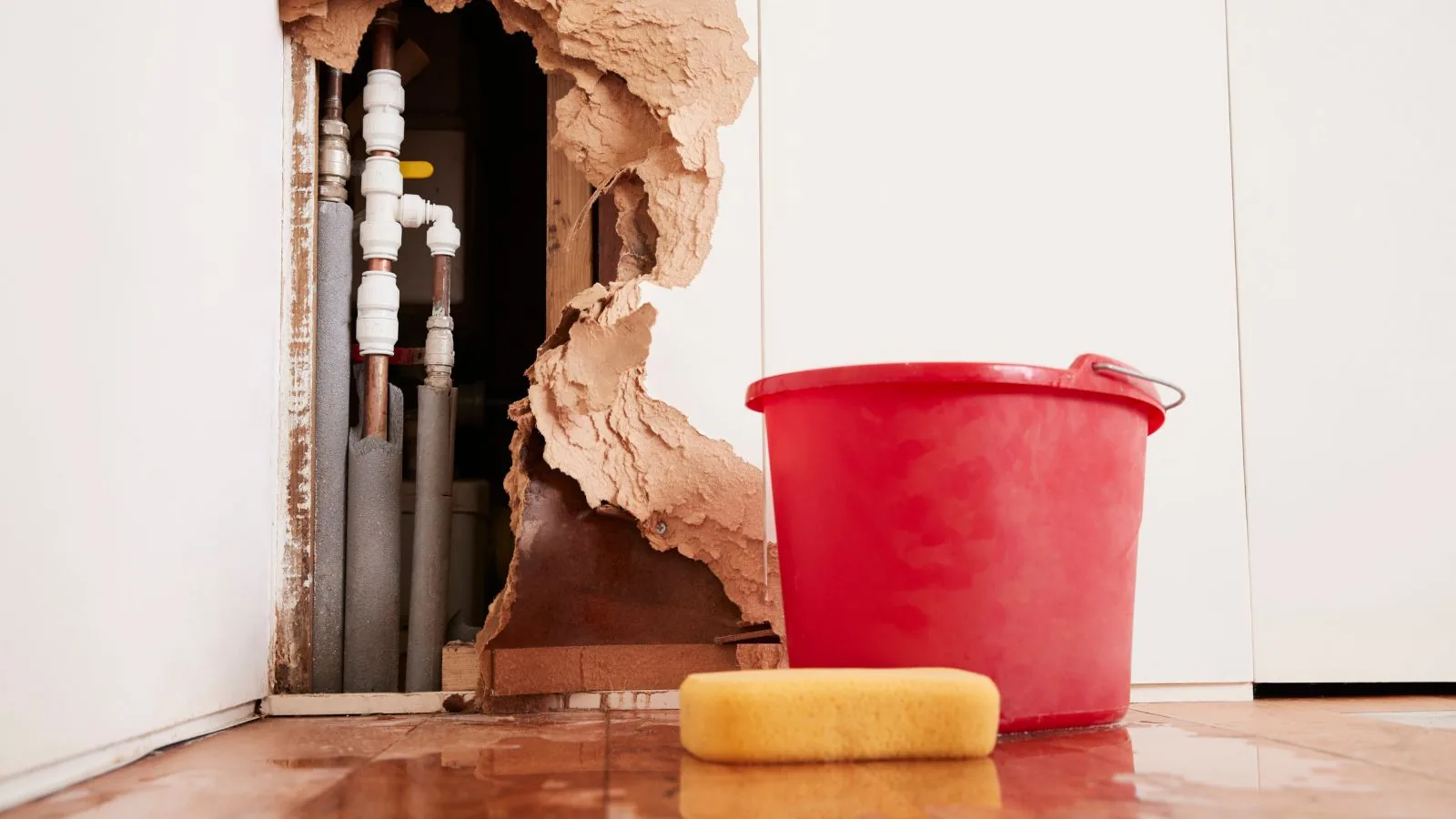
A hidden leak is one you cannot see: inside a wall, under a floor, beneath a slab or in a ceiling cavity. It often announces itself through your water bill, a smell or a stain long before there is a puddle. The steps below let you narrow it down before you call a plumber, and they explain where a restoration crew fits in.
Start with the meter
- Turn off every fixture and appliance that uses water, including the ice maker and any irrigation.
- Find your water meter and look at the leak indicator, usually a small dial or triangle that spins when water moves.
- Note the reading, wait 30 minutes without using any water, and look again.
- If the reading moved or the indicator spins, water is leaking somewhere on your side of the meter.
- If you can close the main valve at the house and the meter stops, the leak is inside. If it keeps moving, it may be between the meter and the house.
The meter is outside the home, usually near the street, and the lid can be hard to open. The city's Water Office at (650) 558-7210 can help locate it. Do not force a lid, since some carry wires.
Check the bill
Compare recent bills for a month when your habits were similar. A steady rise with no change in use is a clue. The size of a leak is hard to judge from a bill alone, but a plumber can use the meter test above to confirm.
Use your senses
| Sign | Likely location | What to check |
|---|---|---|
| Sound of running water with fixtures off | Supply line in a wall or under a slab | Meter test, then call a plumber |
| Warm spot on a floor | Hot water line beneath the floor | See slab leak water damage |
| Musty smell with no visible source | Wall cavity, crawl space or under cabinets | Moisture meter reading |
| Stain on a ceiling that grows | Pipe, drain or roof above | See ceiling water damage |
| Peeling paint or bubbling wallpaper | Moisture behind the wall | Moisture meter reading |
Fixtures worth checking
- Toilets: add a few drops of dye to the tank and see whether color appears in the bowl without flushing.
- Under sinks: feel the supply lines and drain connections with a dry paper towel.
- Water heater: look for rust, moisture or a damp drain pan.
- Washing machine hoses: look for bulges, cracks and drips at the connections.
- Outdoor spigots and irrigation: look for wet soil or constant sprinkler activity.
When to call a plumber and when to call restoration
A plumber finds and repairs the leak. If water has already soaked into walls, flooring or a ceiling, restoration handles the drying and the damage. If you find a hidden leak that has been running for some time, expect that part of the structure is wet. A moisture meter and thermal camera, as explained in structural drying, show how far it spread.
Pipes that fail suddenly are described on burst pipe water damage, and slower seepage from appliances is covered at appliance leak water damage.
A short example
Say your bill rose over two months and the house has a faint musty smell in a hallway closet. You close every tap, read the meter, wait half an hour and see the dial move slightly. You close the main at the house, the dial stops, and you now know the leak is inside. The closet shares a wall with a bathroom, so you check the tub connection and the toilet supply line first, then call a plumber with that information.
That sequence shortened the plumber's search and gave the restoration crew a place to start reading moisture. Even if you never find the exact spot, writing down the meter reading, the time and what you checked is useful to anyone who comes after.
What not to do
- Do not cut into walls randomly. A meter and thermal camera narrow the target.
- Do not ignore a small stain. Stains that grow mean the source is still active.
- Do not paint over a stain before the area is dry and the source is repaired.
A Burlingame note
Burlingame buys its water from the San Francisco Public Utilities Commission, and the city's Water Division maintains the mains up to the meter. A leak before the meter is the city's to repair. Reports go to 650-558-7670 on weekdays or through the Burlingame Police Department at 650-692-0604 after hours. A leak after the meter is yours, and the meter test above helps tell the two apart.
If you rebuild walls or replace piping after finding a leak, the Building Division at 650-558-7260 can say whether a permit is needed. See the pages for San Mateo and El Granada to see how calls from nearby places are handled.
Frequently asked questions
How do I know if the meter is moving?
Turn off all water use, read the meter, wait 30 minutes and read it again. Movement means water is flowing somewhere.
Can a small leak run up a bill?
It can add up over time. A plumber can estimate the size from the meter.
Who finds the leak, a plumber or restoration?
A plumber finds and repairs it. Restoration dries and repairs the damage.
What if the leak is before the meter?
That is the city's side. Report it to Public Works at 650-558-7670 on weekdays or the Burlingame Police Department at 650-692-0604 after hours.
Where do I find the Burlingame water meter?
It is usually outside near the street. The city's Water Office at (650) 558-7210 can help if you cannot locate it.
Water still spreading or not sure what you are looking at? The line is open 24/7.
✆ Call (833) 521-1033